
When an agent builds the shortlist, the top of your funnel stops being a place people arrive and becomes a test you either pass or fail. Silently. Before any of it shows up in your analytics.
That is the whole change, and it is less apocalyptic than it sounds. The stages still exist. Two of them have simply moved inside a system you do not own, which means the only evidence you get about them is whether you survived.
The same buyers, a shorter path
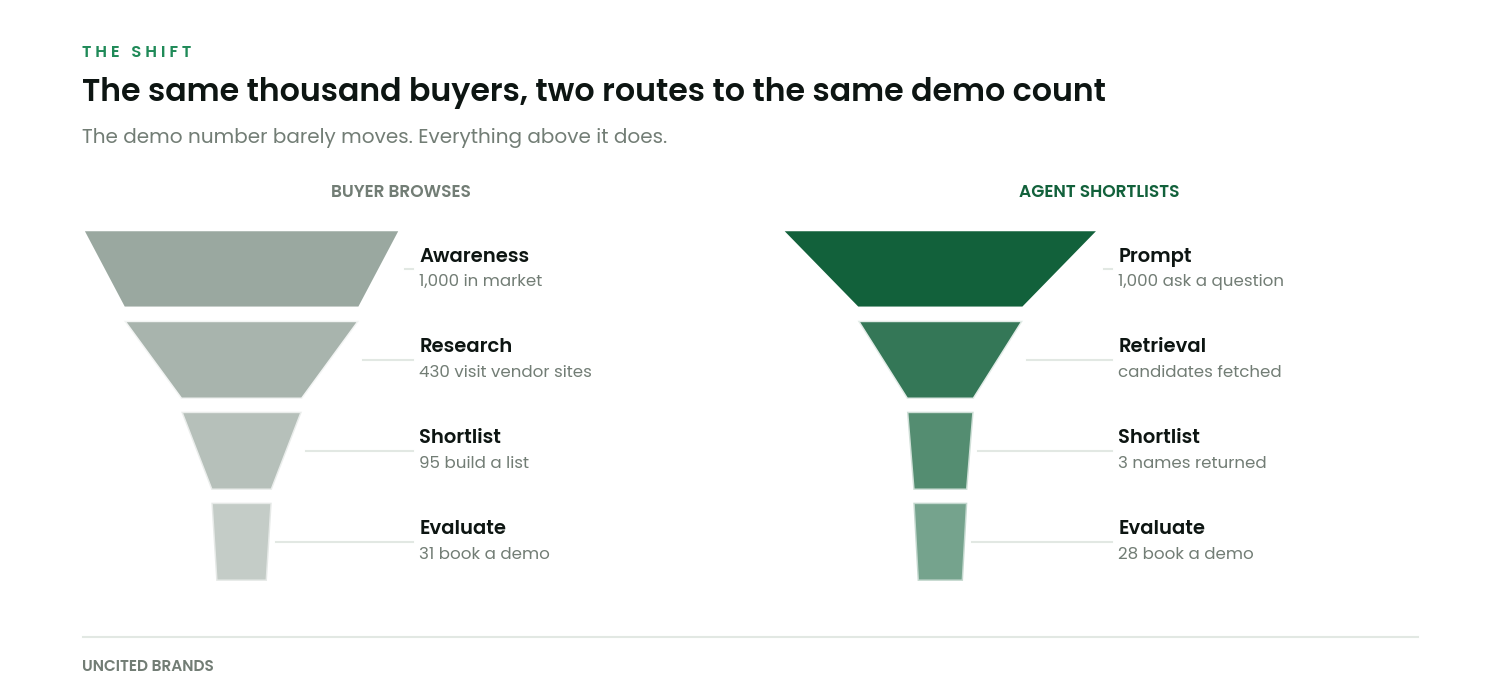
Look at the bottom row of both funnels before anything else. The demo count barely moves. The number of people who end up in a serious conversation with a vendor is roughly stable, because it is governed by how many organisations actually have a problem and a budget, not by how they shop.
Everything above that row changes a great deal. The buyer who would have visited six vendor sites now visits two, having been handed three names. Your site is no longer where consideration happens. It is where consideration gets confirmed.
The metric trap. Sessions fall, demo count holds, and conversion rate goes up sharply. Read together that is a good quarter. Read as a traffic chart it looks like a disaster, and the people who read it that way tend to respond by publishing more pages, which does nothing.
What the agent is actually doing
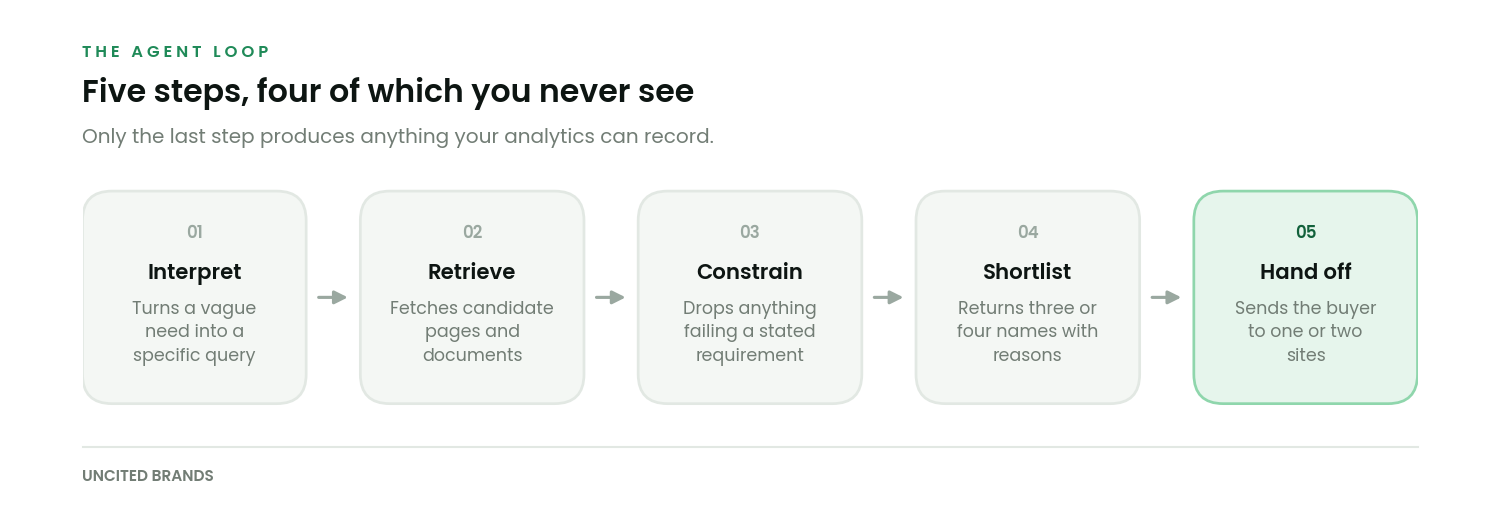
Interpret. The buyer says something vague. The agent turns it into something specific, usually by inventing constraints the buyer implied but did not state. This step is invisible and it is where a lot of fate is decided.
Retrieve. Candidate documents are fetched. If your pages are not reachable, not parseable or not clearly about the category, you are already out. Nothing later in the loop can recover a vendor that was never fetched.
Constrain. Stated requirements are applied as hard filters. Does it integrate with the thing they named. Does it serve companies of that size. Is there a price under the ceiling. A missing answer is treated as a failed answer far more often than it is treated as unknown, which is the single most expensive thing in this piece.
Shortlist and hand off. Three or four names, with a sentence of reasoning each, and then the buyer clicks one or two. Agent frameworks that interleave reasoning with tool calls, the pattern described in the ReAct paper and now standard in commercial systems, will often loop back and re-query rather than settling on the first set. That is good for you. It means a near miss on the first pass is not always final.
Worth knowing before you restructure anything.
Most teams reading this want to know whether it is already happening to them. The free check runs a buyer-shaped question set and tells you whether you survive the constrain step, which is where most SaaS companies are being dropped. Run it on your category.
Which pages suddenly carry the whole load
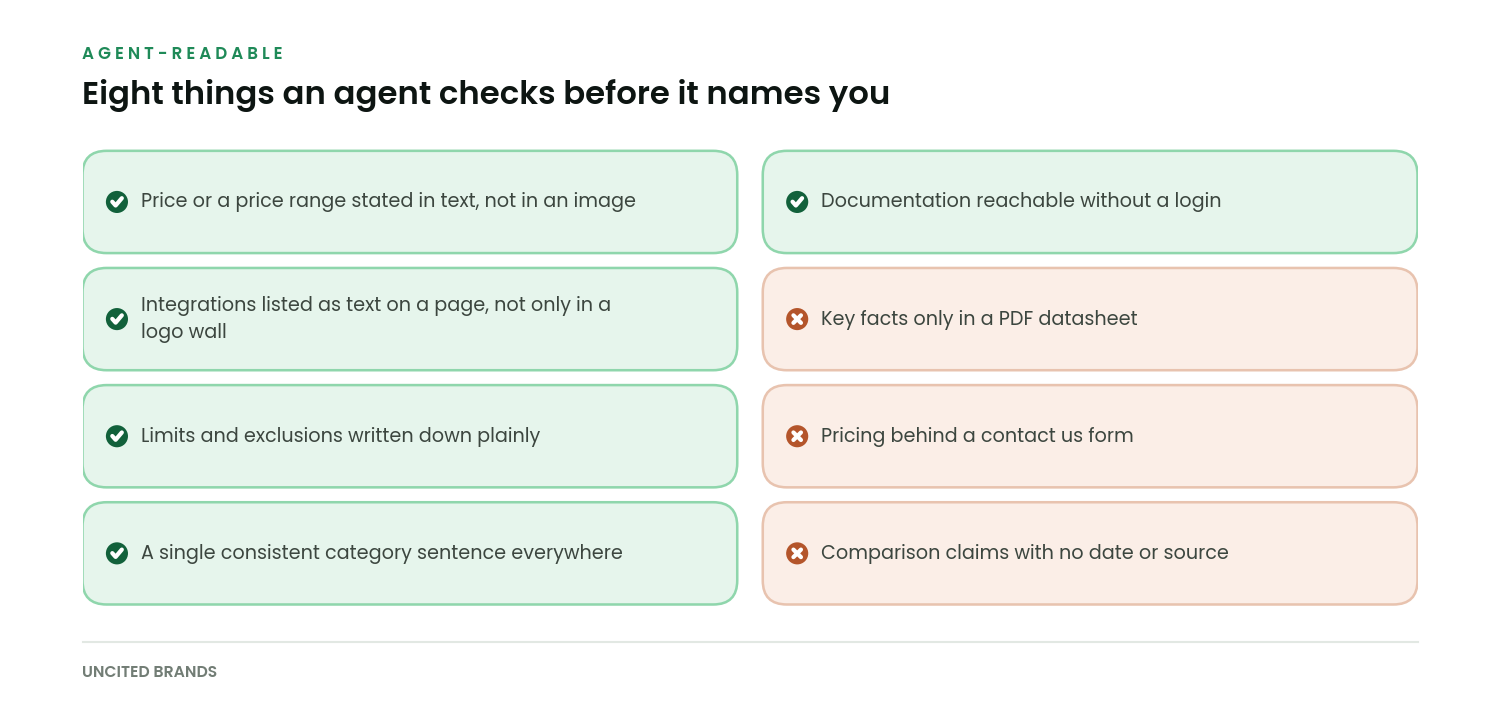
The pages that answer constrained questions in plain text. That is the entire list, and it is not the list most marketing sites are built around.
| Page | Old job | New job | Usually fit for it |
|---|---|---|---|
| Homepage | First impression, brand | Stating the category in one unambiguous sentence | No |
| Pricing | Capture a lead | Passing or failing a budget filter | Rarely |
| Integrations | Logo wall for credibility | Answering does it work with X as text | No |
| Documentation | Support existing customers | The most retrieved asset you own | Often, by accident |
| Comparison pages | Capture competitor searches | Supplying the reasoning sentence next to your name | Sometimes |
| Case studies | Social proof for humans | Evidence that you serve that segment | Rarely, no segment stated |
| Blog | Top of funnel traffic | Mostly nothing, unless it answers a real question | No |
Documentation deserves a note. It is the most consistently retrieved thing on a SaaS site and it is usually the only part written by people who were not trying to persuade anyone. That is exactly why it performs. It states limits, names versions and says what does not work, which is the kind of specificity that survives the constrain step.
What to stop measuring, and what to start
Top of funnel sessions are no longer a measure of reach. They are a measure of how many shortlist appearances converted into a visit, which is a different and much narrower thing. If you keep them as your headline number you will systematically misread your own performance for the next few years.
The replacement is whether you are named at all, measured against a fixed question set per engine. We call that share of model and the term is being ruined at speed by vendors reporting it with no method behind it, which does not make the underlying idea less useful.
- Keep: demo requests, pipeline, win rate by source. These still mean what they meant.
- Demote: sessions, impressions, keyword rankings. Still worth watching, no longer worth steering by.
- Add: named appearances per engine against a dated question set, and the share of first visits landing on pricing or docs rather than the homepage.
- Watch: the gap between being named and being linked. Some engines name far more vendors than they link to, and the gap is where your attribution disappears.
How fast this is actually moving
Slower than the vendor pitches suggest and faster than most marketing plans assume. Research on B2B buying behaviour from firms like McKinsey has been describing a long shift toward self-directed, multi-channel research for a decade, with buyers spending a shrinking share of the process in contact with any vendor. Agents are a continuation of that line rather than a break in it.
What is genuinely new is the machine readable layer underneath. Standards for giving agents structured access to tools and data, such as the Model Context Protocol, are moving from research into normal infrastructure. When an agent can query a product catalogue directly rather than reading a marketing page about it, the advantage shifts further toward whoever published clean, specific, dated facts.
There is a useful precedent here. Schema.org began as a search engine convenience and became the default way machines read commercial web pages. The current round of agent protocols is at roughly the same stage, which means the cost of participating is low and the cost of waiting compounds quietly.
The honest caveat
Nobody knows the final shape of this and anybody telling you they do is selling. What we can say is that every one of the fixes this change rewards was already a good idea. Stating your price. Writing down your limits. Describing yourself the same way twice. Keeping documentation public. None of that is a bet on agents. It is just work that now has a second payoff.
If you want the broader view of where this is heading, agents are already shopping for software covers the buying side in more detail, and where AI search is going sets out what we think is reasonably predictable and what is not.
Related reading
- Agents are shopping for software. The buyer side of the same change, in more detail.
- Where AI search is going. What we think is predictable, and what is guesswork.
- What buyers actually ask. The constrained questions that decide the shortlist.
- Your pricing page. The page that fails the constrain step most often.
Your funnel did not get worse. It got shorter, and the first half moved somewhere you cannot see.
The response that works is unglamorous. Write down the facts an agent needs to clear a filter, put them in text on pages that do not require a login, and stop describing yourself three different ways on three different pages.
We send one piece a week on what is actually changing, with the tests behind it. Subscribe here.

Shaban runs answer engine optimisation for B2B SaaS companies at Uncited Brands. He works the unglamorous end of the problem, mostly crawler access, retrieval diagnostics and measurement baselines, and publishes the tests that do not go his way alongside the ones that do.