
Nobody can guarantee you a position in an AI answer. Not us, not the agency pitching you next week, not anybody, because the thing being promised is the output of a system none of us operate. When you see a guarantee, the useful question is not whether it is true. It is what the guarantee has quietly been redefined to mean.
That is worth saying plainly because the answer is usually innocent. Most guarantees are not fraud. They are a real promise about something small, written in language that sounds like a promise about something large.
Start with what can actually be controlled
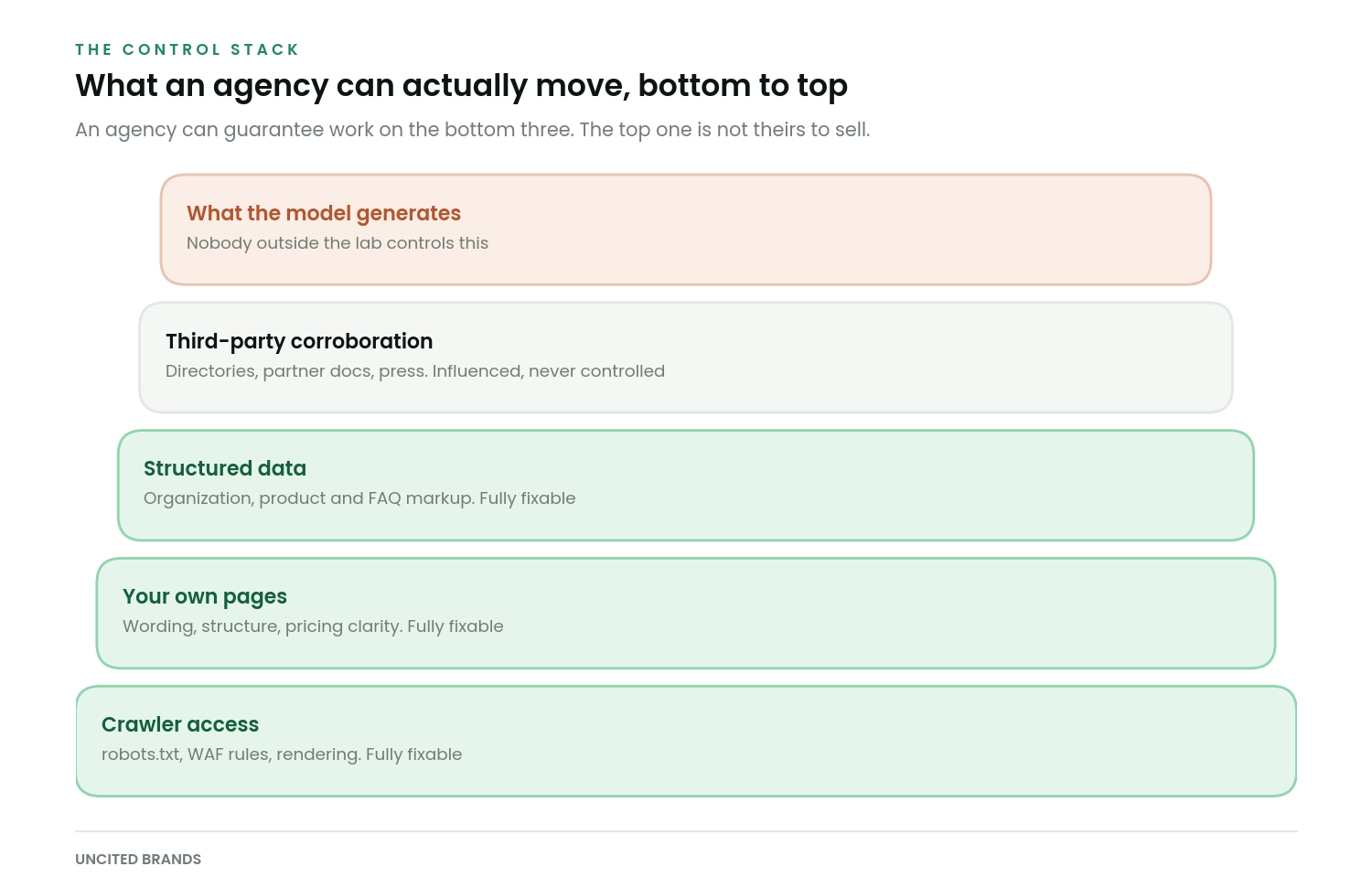
Everything below the top layer is ordinary work. Crawler access is a configuration problem with a right answer. Your own pages are yours. Structured data is a file you deploy. Third-party corroboration is slower and partly outside your hands, and it still responds to effort.
The top layer is different in kind. What a model generates for a given question varies between runs by design. Both OpenAI and Anthropic document sampling parameters that make repeated answers to an identical prompt differ. An agency guaranteeing a named position in that output is guaranteeing the behaviour of a system they cannot configure, for a question they did not write, at a time they do not choose.
The one-line test. Ask what happens if the model provider ships an update next month. If the guarantee survives that answer unchanged, it was never about the model.
What a guarantee usually turns out to mean
There are four common versions. None of them is illegal and all of them are worth knowing before you sign.
| The promise | What it usually means | The question that settles it |
|---|---|---|
| Guaranteed appearance in ChatGPT | Mentioned anywhere in any answer to any question, including questions containing your brand name | Does the prompt set include our name? How many of the forty questions do? |
| Guaranteed first position | First in a list the agency generated, from a prompt the agency wrote, on a day the agency chose | Who writes the questions, and when are they fixed? |
| Guaranteed visibility score increase | A proprietary index with undisclosed weights, which can be moved by changing the weights | Can I reproduce this number from the raw outputs myself? |
| Money back if we miss | A real promise, often with a scope so narrow that missing is close to impossible | What exactly triggers the refund, in one sentence? |
The pattern is consistent. The promise is about an outcome and the definition is about an artefact the agency produces. That is not always cynical, because measuring AI visibility honestly is genuinely hard and some of these definitions started as reasonable shortcuts. It becomes a problem when the shortcut is never disclosed.
If you are mid-pitch and want a second read on a proposal, send it over. We will tell you which parts are standard, which are defensible and which would not survive a question, and we will do it whether or not you ever work with us. Book a short call.
The same three months, written two ways
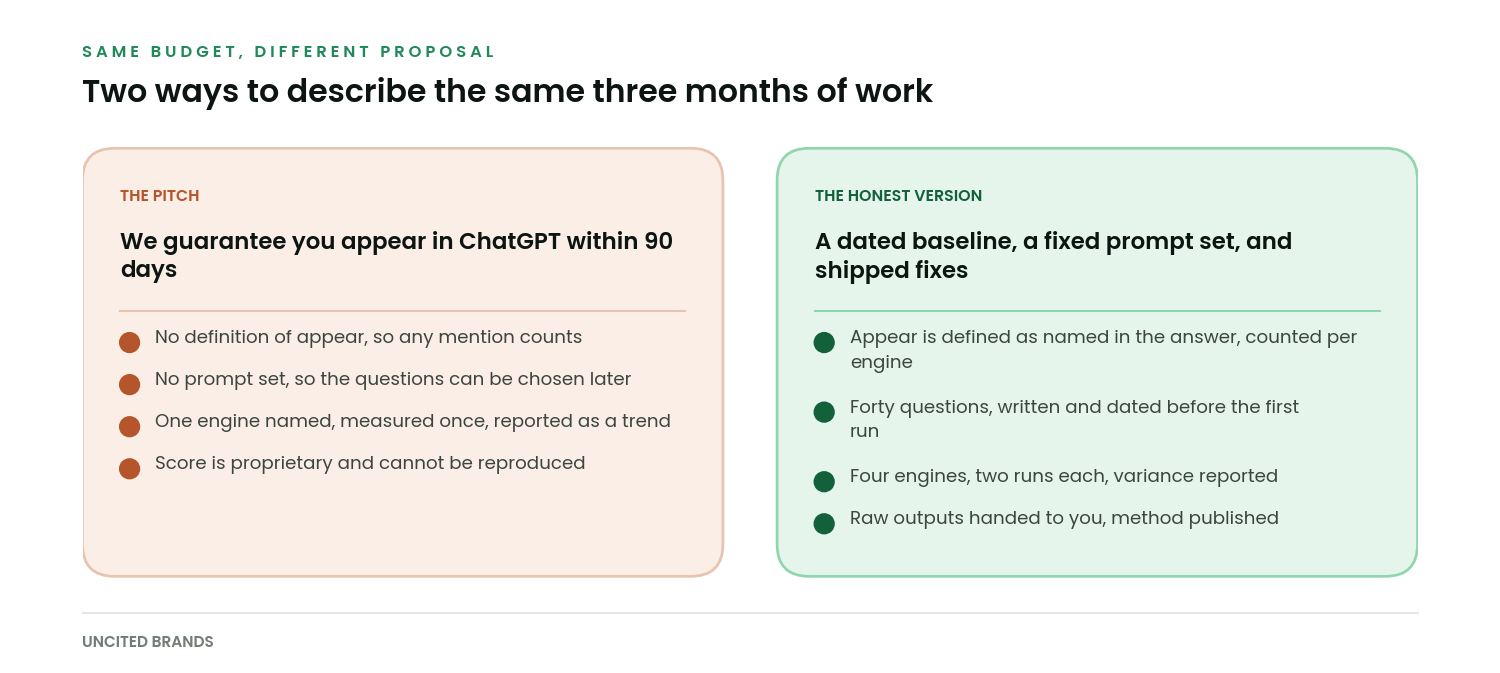
The work behind both of those proposals can be identical. The difference is entirely in whether you are given the means to check it. A fixed prompt set, written and dated before the first run, is the single most important line in any AEO contract, because without it every number that follows can be made to say whatever is convenient.
We have written the longer version of this as twelve questions to ask before you sign. This piece is the shorter, blunter companion, aimed at the specific moment when somebody uses the word guaranteed.
Eleven red flags, roughly in order of how much they should worry you
- A guaranteed position with no definition of position. The definition is the whole product.
- A proprietary score you cannot reproduce. If the number cannot be rebuilt from the raw outputs, it is a rendering of their business model rather than a fact about your company.
- Blended engine reporting. One number across four engines hides the only detail you could act on, since the engines fail you for different reasons.
- Mentions counted, not read. A mention in a list of tools to avoid counts the same as a recommendation in a mention count.
- A baseline with no date. Without a date it is not a baseline, it is a screenshot.
- Prompt sets written after the first look. Choosing questions once you know the answers roughly doubles any share figure, in our experience, and it is undetectable from the outside.
- Refusal to show a failed test. Anybody who has done this work for a year has tests that went against them. Having none on file means either very little work or very selective filing.
- Volume promises. Thirty pages a month is an output, not an outcome, and in this discipline it is frequently an active harm.
- No named owner of crawler access. If nobody in the proposal is responsible for checking that the bots can reach you, the rest of the plan is decoration.
- Case studies with no method. Self-reported numbers with no protocol are not evidence, which is a problem across the whole category rather than one agency.
- Urgency about a closing window. There is no window. The work compounds and it will still work in March.
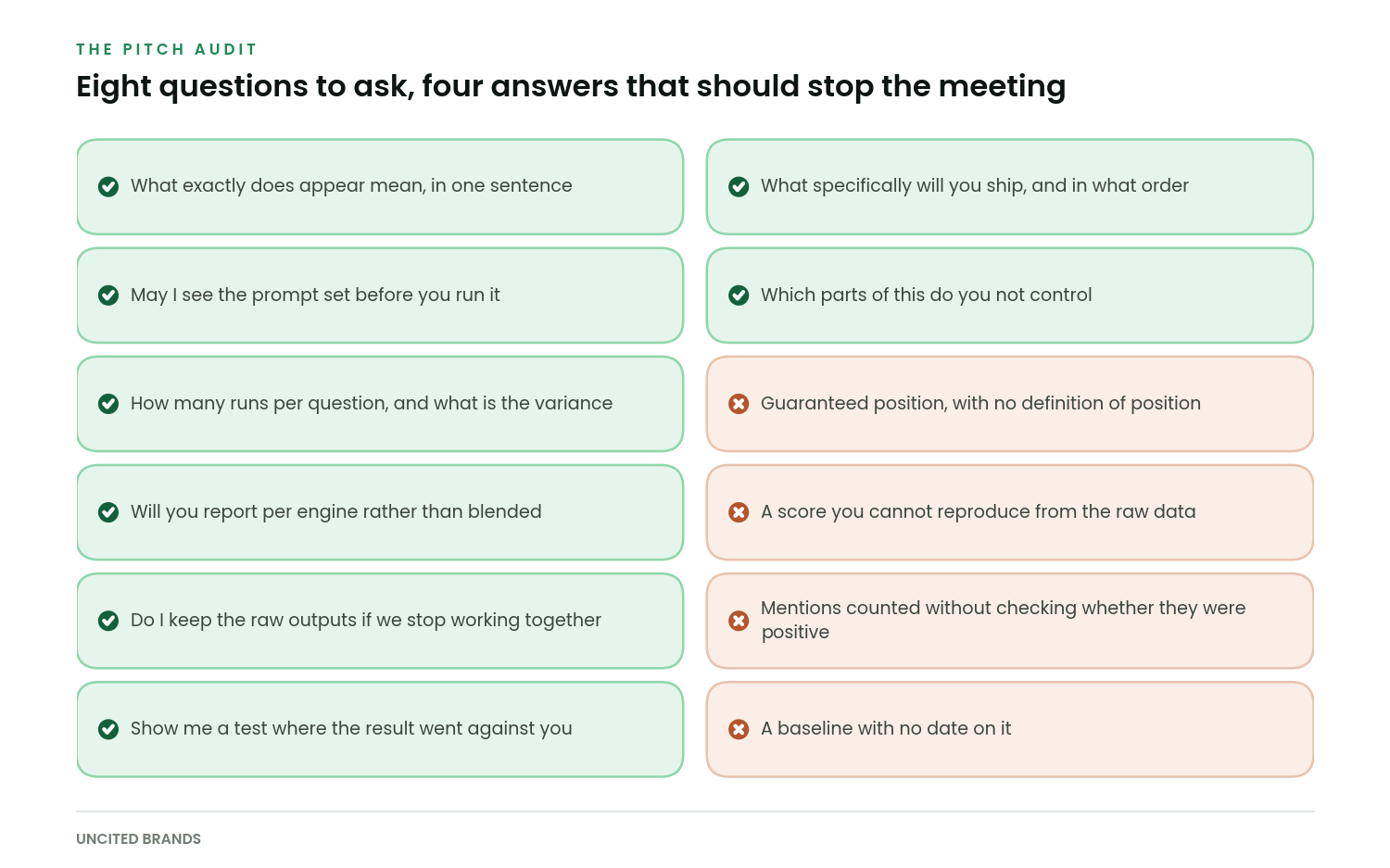
A proposal you cannot check is a proposal about trust, and trust is a poor substitute for a method.
Our own protocol is published in full, including the parts that make our numbers look worse than a competitor using a friendlier definition. That is not generosity. It is the only way a number in this field means anything at all.
Book a visibility audit if you want a baseline built that way. The output is yours to keep and to take to somebody else.
What an honest pitch sounds like
It is less exciting, and it contains the word cannot more than once. A good proposal says something close to this.
We will fix crawler access and prove it with log evidence. We will rewrite these six pages to answer these specific questions in the first two sentences. We will correct your listings on these four directories. We will run this fixed set of forty questions, which you have now seen, across four engines twice a month, and report per engine with the variance shown. We expect the first movement in eight to twelve weeks on retrieval and later than that on citation. We do not control what the models generate and we will not pretend to. Here is a test from last quarter where our changes made no measurable difference.
That last sentence is the one worth listening for. The price range in this market is wide enough that you can pay premium money for either version, so the only thing separating them is whether anybody will show you their working.
The regulatory angle, briefly
Guarantees about outcomes you do not control are not only a commercial risk. Advertising rules in most markets require that objective claims be substantiated before they are made. The Federal Trade Commission in the United States and the Advertising Standards Authority in the United Kingdom both take the position that the advertiser holds the evidence, not the complainant. An agency that cannot show you the method behind a guarantee probably could not show a regulator either.
There is also a measurement standards point. The National Institute of Standards and Technology framework for AI risk is explicit that claims about AI system behaviour need stated measurement conditions to mean anything. That is exactly what a dated prompt set is. It is not bureaucracy, it is the minimum for a number to be comparable to itself three months later.
If you have already signed one of these
It is recoverable and it is not usually a disaster. Ask for the raw outputs, in full, for every run to date. Ask for the prompt set with its creation date. If both arrive, you can rebuild an honest baseline yourself from their own data and carry on with better reporting. If either is refused or does not exist, you now know exactly what you have been buying, and the answer is reporting rather than work.
Either way the underlying fixes are durable. Crawler access, page wording and directory accuracy keep working regardless of who did them or how badly the reporting was framed.
Related reading
- The buyer’s guide. The full selection process this piece is one chapter of.
- Twelve questions to ask. The longer list, with the answers you should expect.
- Agency, SEO agency or in-house. Whether you need an outside party for this at all.
- What share of model is. The metric most of these guarantees are quietly redefining.
Ask for the prompt set. Everything else follows from that.
If it exists, is dated, and you are allowed to read it before the first run, you are probably talking to somebody serious. If it does not exist yet, every number in the proposal was produced after the fact and can be produced again differently.
We will read a proposal you are considering and tell you where it is soft, with no expectation that you hire us. Book twenty minutes.

Shaban runs answer engine optimisation for B2B SaaS companies at Uncited Brands. He works the unglamorous end of the problem, mostly crawler access, retrieval diagnostics and measurement baselines, and publishes the tests that do not go his way alongside the ones that do.