
Every page an AI engine could cite when answering a question about you is a holding in a portfolio. You did not consciously build it, nobody owns it on your org chart, and it is probably the most valuable marketing asset you have that nobody is managing.
The portfolio framing is not decoration. It earns its place because the two things that matter most about this asset are the two things that matter most about any portfolio. The mix, and the concentration.
What is in it
Four groups, and they behave completely differently.
| Group | Examples | You control it | How it decays |
|---|---|---|---|
| Pages you own | Product pages, pricing, documentation, glossary, changelog | Completely | Only when you change them, or break crawler access |
| Listings | Review directories, app marketplaces, category indexes | Partially. You can correct, not control | Taxonomy changes, redesigns, listings going stale |
| Partner surfaces | Integration docs written by companies you connect to | By relationship | When the partnership or their docs change |
| Independent writing | Press, analyst notes, forum threads, newsletters | Not at all | Slowly, and it is the most durable of the four |
Most marketing teams can name the first group and have never audited the other three. That is the gap, and it is where almost all the surprises live.
Take the inventory
This takes an afternoon and nobody does it. Write twenty to forty questions a buyer in your category would ask, fix the list before you look at any results, and run it across three or four engines. Then ignore the answers and collect the sources.
- Record every URL cited or linked, per question, per engine.
- Group each one by who controls it, using the four groups above.
- Count the share of citations each group accounts for, and the share from the single largest individual source.
- Note which of your own pages appear, and which do not. The absences are usually more interesting than the presences.
The method matters more than the tooling, and the method is the same one we publish for everything else. Our full protocol is open if you want to copy it rather than reinvent it. The one rule that cannot be bent is that the question set is written and dated before the first run.
What a healthy portfolio looks like
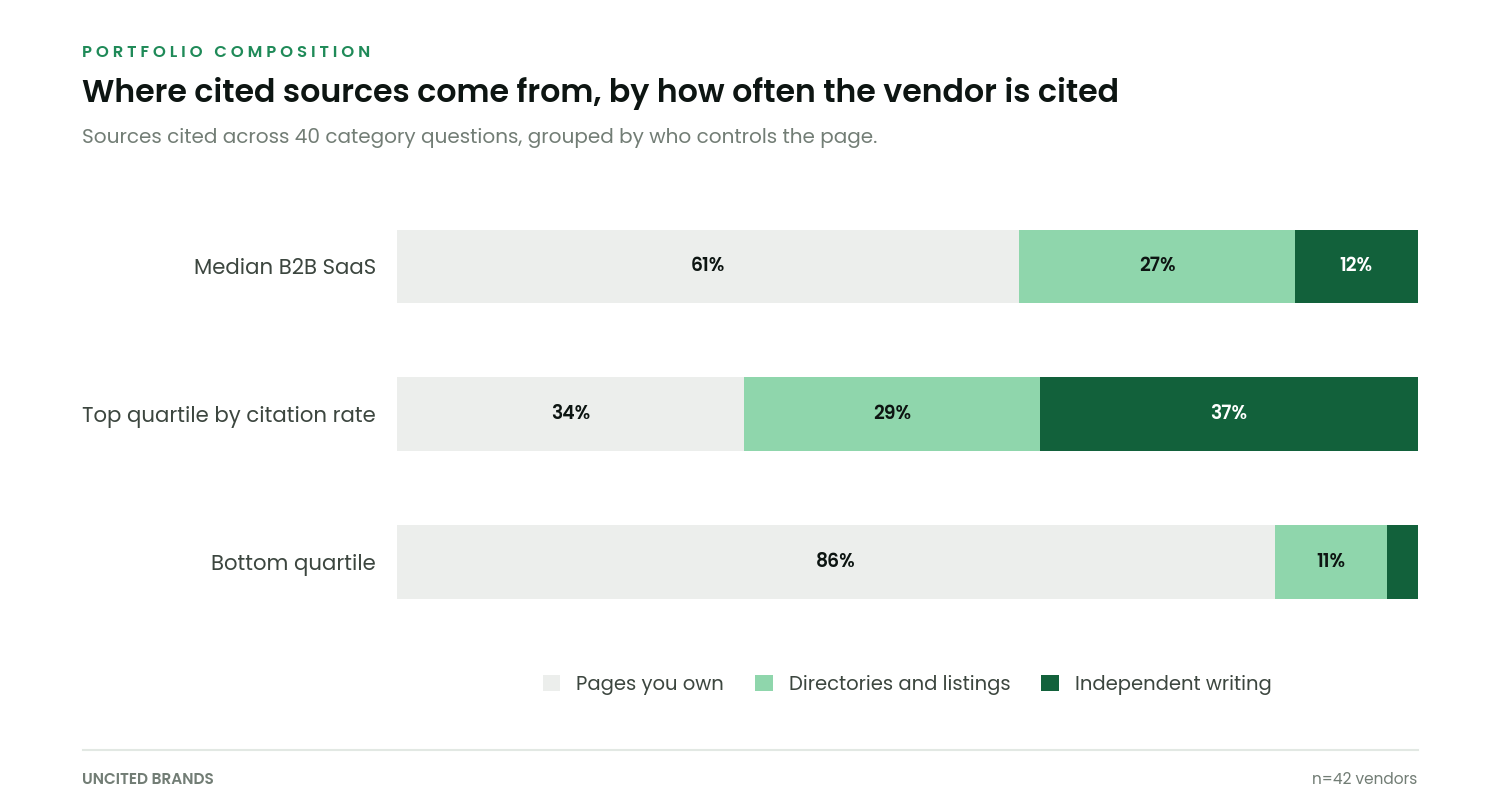
The pattern in that chart is consistent enough that we now use it as a diagnostic. Vendors cited most often are not the ones with the best websites. They are the ones whose citable evidence is spread across sources they do not control.
The bottom quartile is the shape to avoid. Eighty six percent of citable evidence sitting on their own domain means that every claim about them is self-reported, which is exactly the condition under which an engine prefers somebody else. It also means the whole portfolio moves together, which is the definition of concentrated risk.
The counterintuitive bit. Having a smaller share of citations come from your own site is a sign of health, not weakness. The denominator grew. You did not lose anything, you added holdings elsewhere.
Concentration is the risk nobody prices
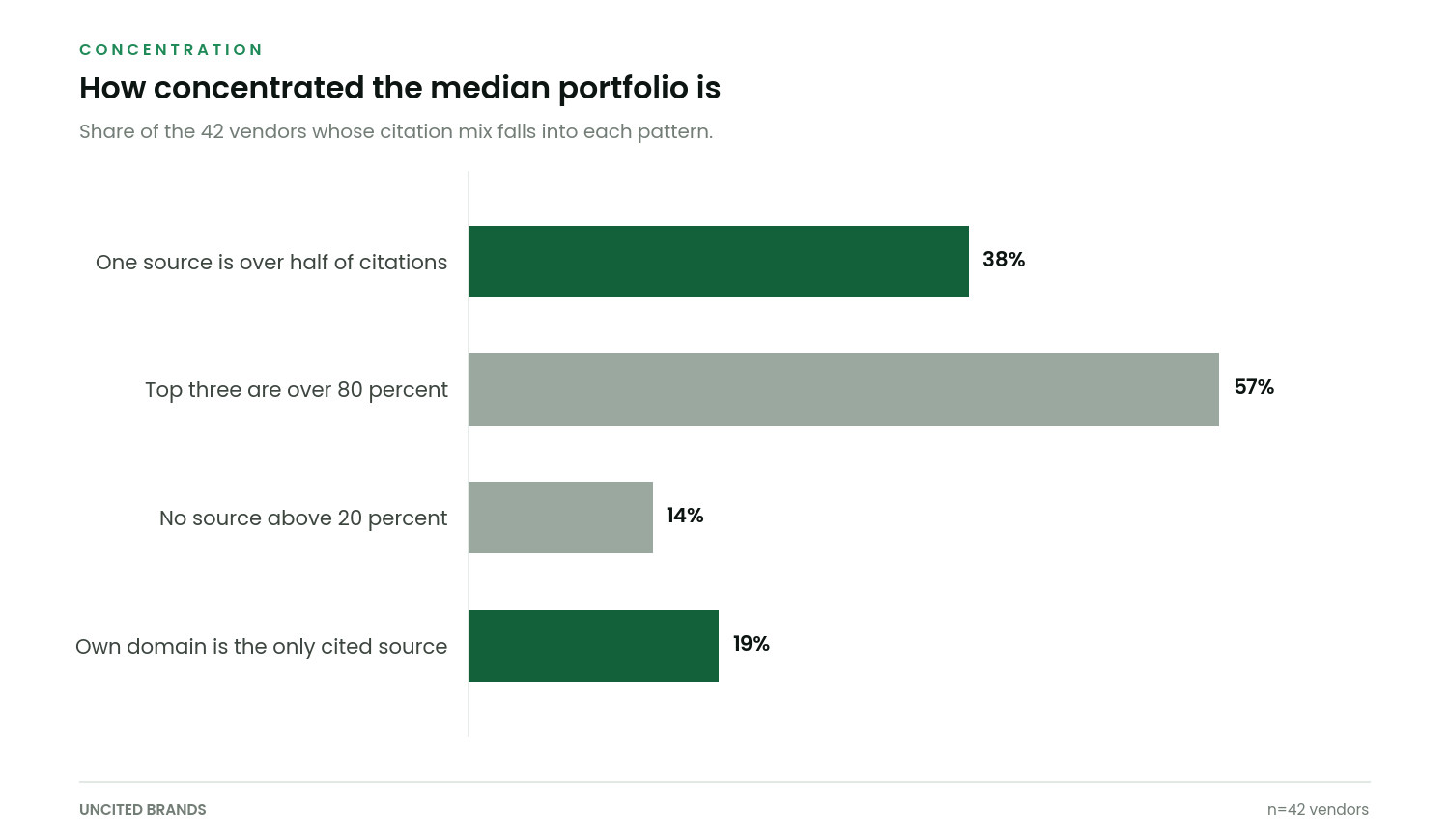
More than half the vendors we looked at have over eighty percent of their citable evidence in three sources. Nineteen percent have exactly one source, their own domain, which is a portfolio in the same sense that a single share is a portfolio.
This matters because the failure is sudden rather than gradual. A review directory restructures its categories and a thousand listings change meaning overnight. A publication puts its archive behind a paywall. A partner rewrites its integration docs and drops the section describing you. None of these are hypothetical and none of them send you an email first.
The intellectual lineage here is ordinary portfolio theory, which has held for seventy years that the risk of a holding is not its own variance but its contribution to the variance of the whole. Harry Markowitz won a Nobel prize for formalising that in 1952 and the insight transfers cleanly. Your riskiest citation source is not the weakest one. It is the one that moves everything else when it moves.
Most teams discover their concentration by accident, usually during a quarter when the number drops and nobody can say why.
An audit maps the whole portfolio, names the single source you are most exposed to, and lists what is cheapest to add next. It takes about a week and the map is yours to keep.
Book one here, or build it yourself from the method above. We would genuinely rather you did it either way than not at all.
What to build next, in order
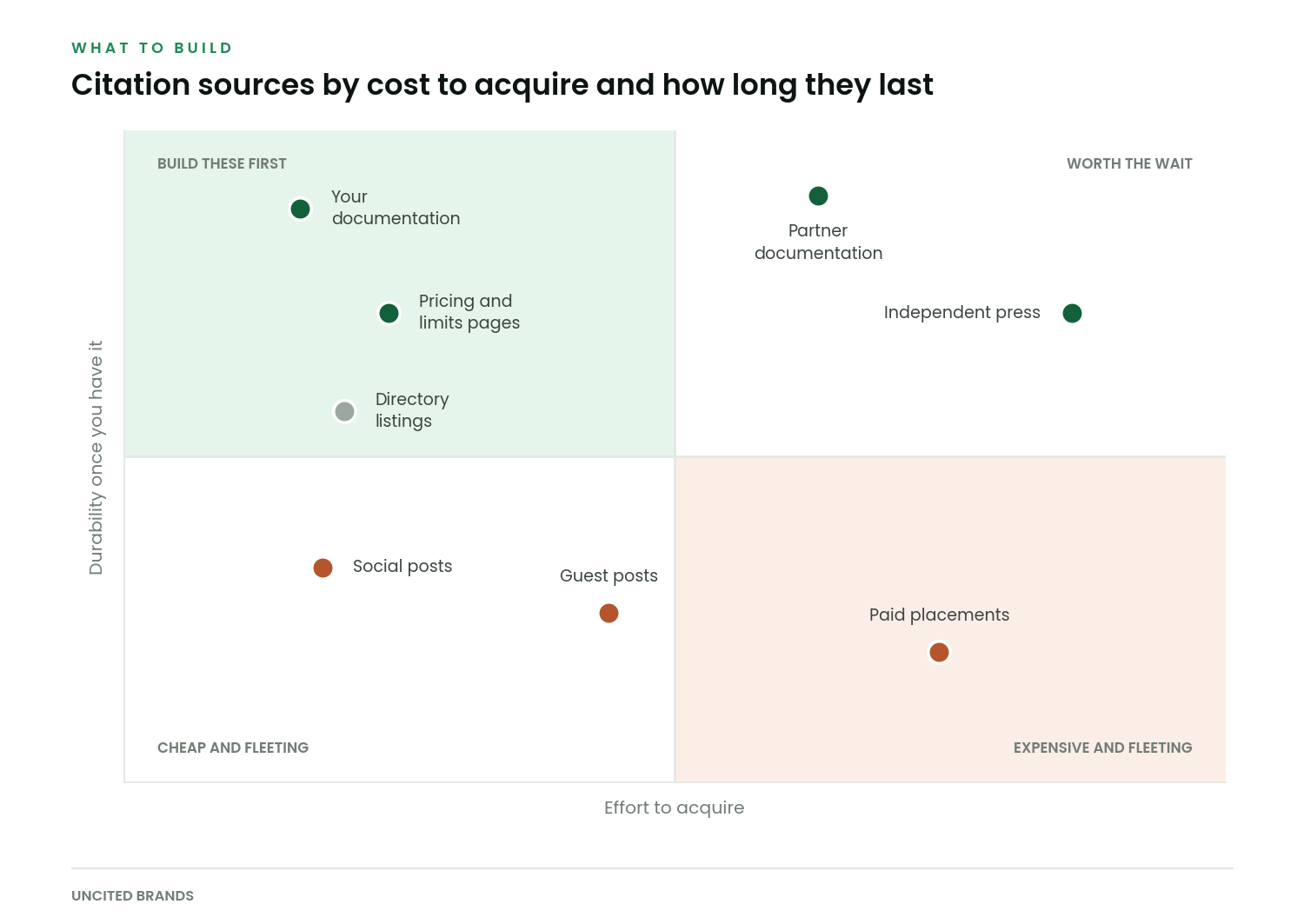
Documentation first, every time. It is the cheapest durable holding available to almost every SaaS company and it is sitting there already. Public, crawlable, specific, written by people who were not trying to persuade anybody. The only thing wrong with most documentation is that it is behind a login or rendered entirely in JavaScript.
Then the pages that state limits. Pricing, security, compatibility, what the product does not do. These get cited disproportionately because they contain the specific facts that resolve a constrained question, and because almost nobody writes them plainly.
Then correct the listings you already have. Not new listings. The ones that exist and are wrong. This is the single most underrated hour of work in the discipline.
Then partner documentation. If you integrate with anybody, their docs page about your integration is a citable source on a domain you do not own, which is precisely what your portfolio is short of. Most of these pages are written once and never reviewed, so asking for a correction is usually welcome.
Independent writing last, and keep expectations calibrated. It is the most durable holding and the slowest to acquire, and you cannot buy it without it becoming a different and much weaker asset.
The two things not to do
Do not mass-produce guest posts. They sit in the worst quadrant, costing real effort and decaying quickly, and at volume they create a pattern that is easy to discount. The portfolio you are building is evaluated on whether independent parties describe you consistently, and forty near-identical posts are one source wearing forty hats.
Do not treat Wikipedia as a growth channel. It is genuinely influential, since a great deal of what models learn comes from broad public corpora such as Common Crawl, and the Wikimedia Foundation has been explicit about how widely its content is reused. It is also governed by notability notability rules that exist specifically to stop companies doing what you are thinking of doing. If you qualify, you probably already have an article. If you do not, attempting one is a waste of a quarter.
How this connects to everything else
A citation portfolio is the asset. Share of model is the return on it. Indexed, retrieved, cited is the mechanism that turns one into the other. If you only have time for one of the three ideas, take this one, because the other two are measurements of something you have to own first.
It also reframes the usual argument about content volume. Publishing more pages adds holdings to the group you already over-index on. It does not diversify anything. That is why so many teams publish relentlessly and watch nothing move, and it is the most common pattern we are asked to explain.
Information diets have been fragmenting for twenty years, and research from organisations like Pew Research Center has tracked how few sources any individual now relies on while the total number of available sources exploded. Answer engines compress that further. Four citations, drawn from whatever happens to be citable. Being in that set is the entire game.
Related reading
- What AEO is. The wider discipline this asset sits at the centre of.
- Share of model. The return figure, and why most reported versions are meaningless.
- Indexed, retrieved, cited. Why a page in your portfolio can still never be used.
- Training data versus live retrieval. Which holdings pay out quickly and which take years.
- How retrieval picks sources. The selection mechanism operating on your portfolio.
Spend the afternoon. Build the inventory. You will not like it, and that is the point.
Nearly every team that does this finds the same two things. More of their citable evidence is self-reported than they assumed, and at least one source they have never thought about is carrying a surprising amount of weight.
We publish one short piece a week, usually a method or a result rather than an opinion. Subscribe if that is your sort of thing.

Shaban runs answer engine optimisation for B2B SaaS companies at Uncited Brands. He works the unglamorous end of the problem, mostly crawler access, retrieval diagnostics and measurement baselines, and publishes the tests that do not go his way alongside the ones that do.