
An engine tells a buyer your product has a feature it does not have, or credits your competitor with something you built. That is not the model being careless. It is entity resolution failing, and entity resolution failures have a specific shape and a specific set of fixes.
Sales tools get this worse than almost any other category, for reasons that are structural rather than unlucky.
What is actually going wrong
Retrieval works on passages, not on products. A system fetches chunks of text that look relevant to a question and composes an answer over them. If a chunk mentions two products and describes four features, something has to decide which features attach to which name. When the text makes that explicit, the decision is easy. When the text says things like “both tools offer sequences and one includes a dialer”, the decision is a coin flip with a bias.
The bias runs toward whichever entity has the stronger existing association with that vocabulary. Which is why the confusion is rarely symmetric. The larger, better described product absorbs attributes from the smaller one, and the smaller one loses attributes it genuinely has.
The asymmetry is the tell. If you are small and being confused with a large competitor, you are losing features to them. If you are large, you are being credited with things you do not do, which generates a different and more annoying problem at demo stage.
Why sales tools specifically
- The vocabulary is tiny and shared. Pipeline, sequences, cadence, enrichment, forecasting, routing. A few dozen terms cover the entire category, and every vendor uses all of them.
- Categories overlap by design. CRM, sales engagement, revenue intelligence and conversation intelligence are four names for four overlapping circles, and most vendors now claim three of them.
- Vendors ship adjacent products. A CRM company launches a dialer. A dialer company launches a CRM. Both keep their own brand on the front.
- Comparison content is enormous. The category has more versus pages than almost any other, and every one of them is a passage containing two product names in close proximity.
- Naming conventions collide. Suffix naming, where the same root takes Cloud, Hub, Engage or Pro, is standard in the category and is the single worst thing you can do for machine disambiguation.
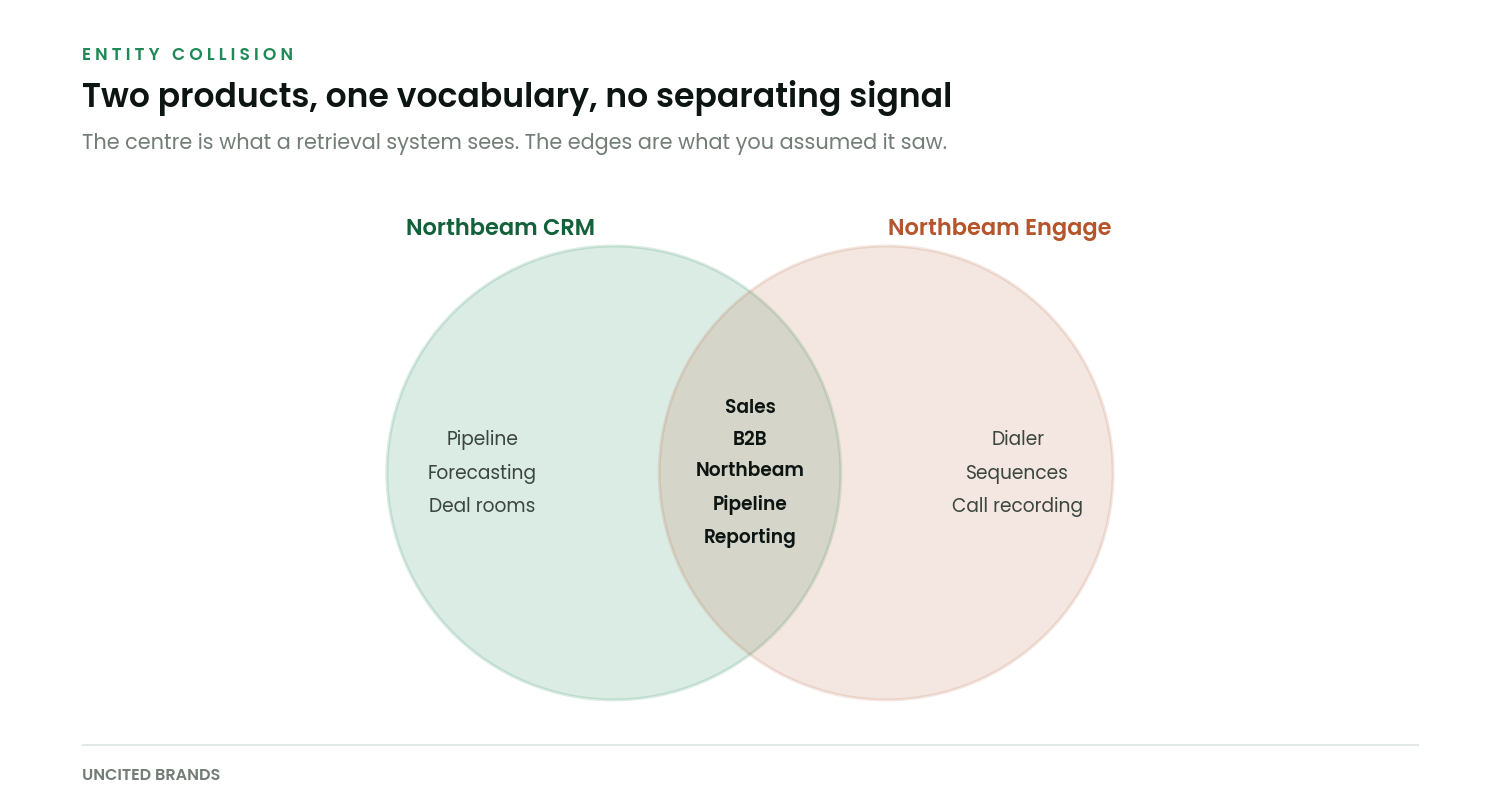
That diagram is the usual self-inflicted version. Two products from the same company, sharing a brand, a domain, a pricing page and most of their descriptive language. The distinguishing features are real and they live at the edges, where there is the least text about them.
If you want to see your own version of that diagram, the free check includes an attribution pass that lists every feature an engine credits to you and flags the ones that are not yours. Run it here.
How to tell which kind you have
Three failure modes, and they need different work. Run twenty questions and read the answers rather than counting them.
| What you see | What it is | Where the fix lives |
|---|---|---|
| Competitor features credited to you | Cross-vendor collision from comparison passages | Your comparison pages, and third-party ones you can influence |
| Your features credited to a competitor | Weak entity, strong neighbour | Your own product pages and directory listings |
| Two of your products described as one | Internal collision | Naming, URLs and schema identifiers. Entirely yours |
| Your old product name still being used | Stale corroboration outliving the rename | Directories, press archives and your own redirects |
| Right features, wrong category | Category drift rather than entity confusion | Your category sentence, everywhere it appears |
That last row is worth dwelling on. A rename takes an afternoon on your own site and roughly eighteen months everywhere else. If you renamed a product in the past two years and still see the old name in answers, nothing is broken. You are watching the lag, and the only accelerant is correcting the directories by hand.
The four fixes, in order of return
One canonical name, everywhere, without variation. Not Northbeam CRM in the markup, Northbeam in the nav, the Northbeam platform in the copy and Northbeam Sales on G2. Pick the string. Use the string. This sounds trivial and it is the single highest-return action in this piece.
Give each product a stable identifier. Distinct URL, distinct schema node, and a persistent @id that does not change. This is the same principle behind public entity databases like Wikidata, where every item gets an opaque identifier precisely so that labels can change without the entity dissolving. You are building a small version of that for yourself.
{
  "@context": "https://schema.org",
  "@id": "https://northbeam.example/crm/#product",
  "@type": "SoftwareApplication",
  "name": "Northbeam CRM",
  "applicationCategory": "BusinessApplication",
  "applicationSubCategory": "CRM",
  "isRelatedTo": { "@id": "https://northbeam.example/engage/#product" },
  "publisher": { "@id": "https://northbeam.example/#org" }
}
The isRelatedTo line is doing real work. It states that the two products are connected and distinct, which is exactly the fact a system is otherwise guessing at. Linked data conventions for this are set out in the W3C RDF concepts specification, and the relevant idea is simply that identity is carried by the identifier rather than by the label.
Write the negative sentence. One line on each product page saying what it is not. “Northbeam Engage is a sales engagement tool for outbound teams. It is not our CRM, which is Northbeam CRM.” Humans find this slightly odd to read and machines find it enormously useful, which is a trade worth making once per product page.
Fix the directories. Category tags on review sites are repeated by engines with more confidence than the listings deserve, and they are frequently years out of date. This is tedious, unglamorous, and it moves the number more reliably than anything you publish on your own site.
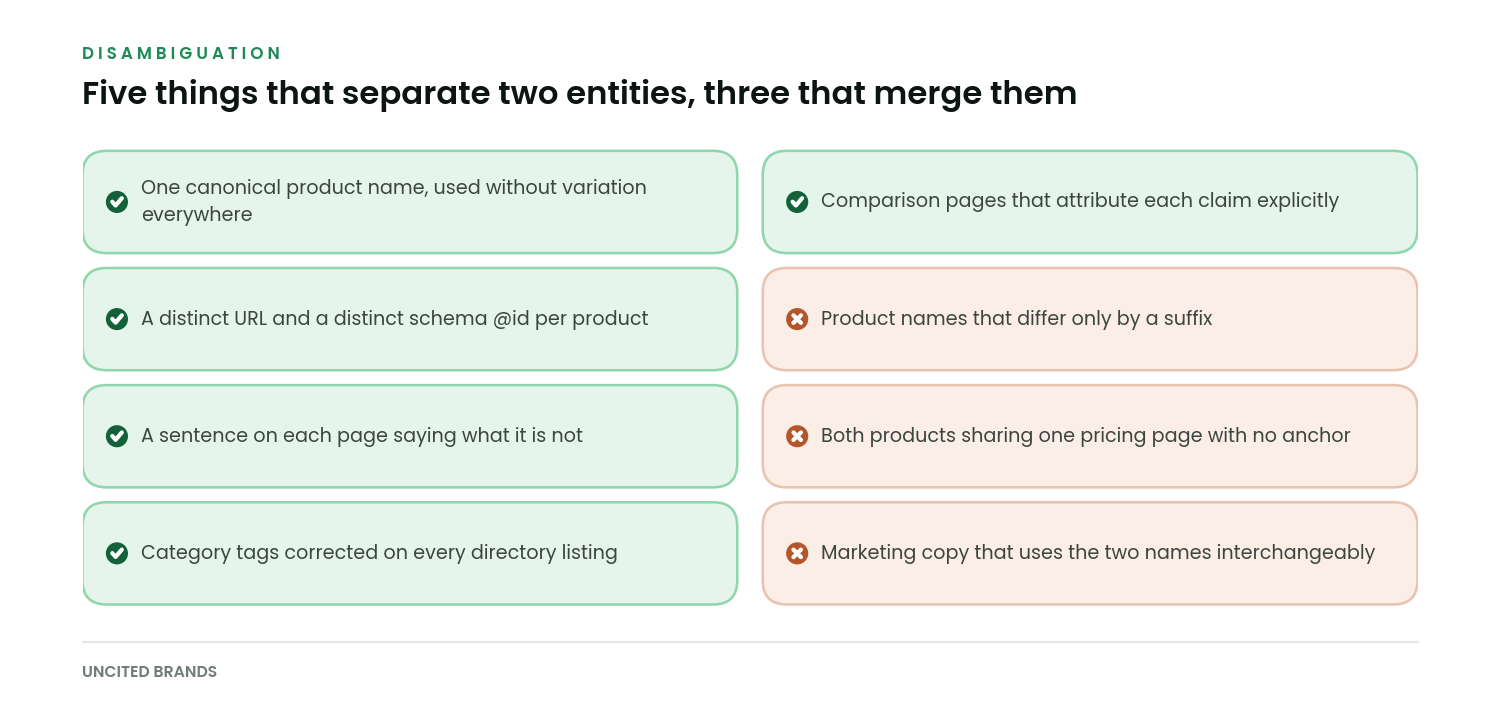
This one is genuinely fixable on a short timeline.
Most AI visibility work pays out in quarters. Entity disambiguation is the exception, because you are correcting a specific wrong fact rather than building a reputation. Twelve weeks is a normal time to see most of the improvement. Talk to us about it if you want the full attribution map first.
What the fixes are worth
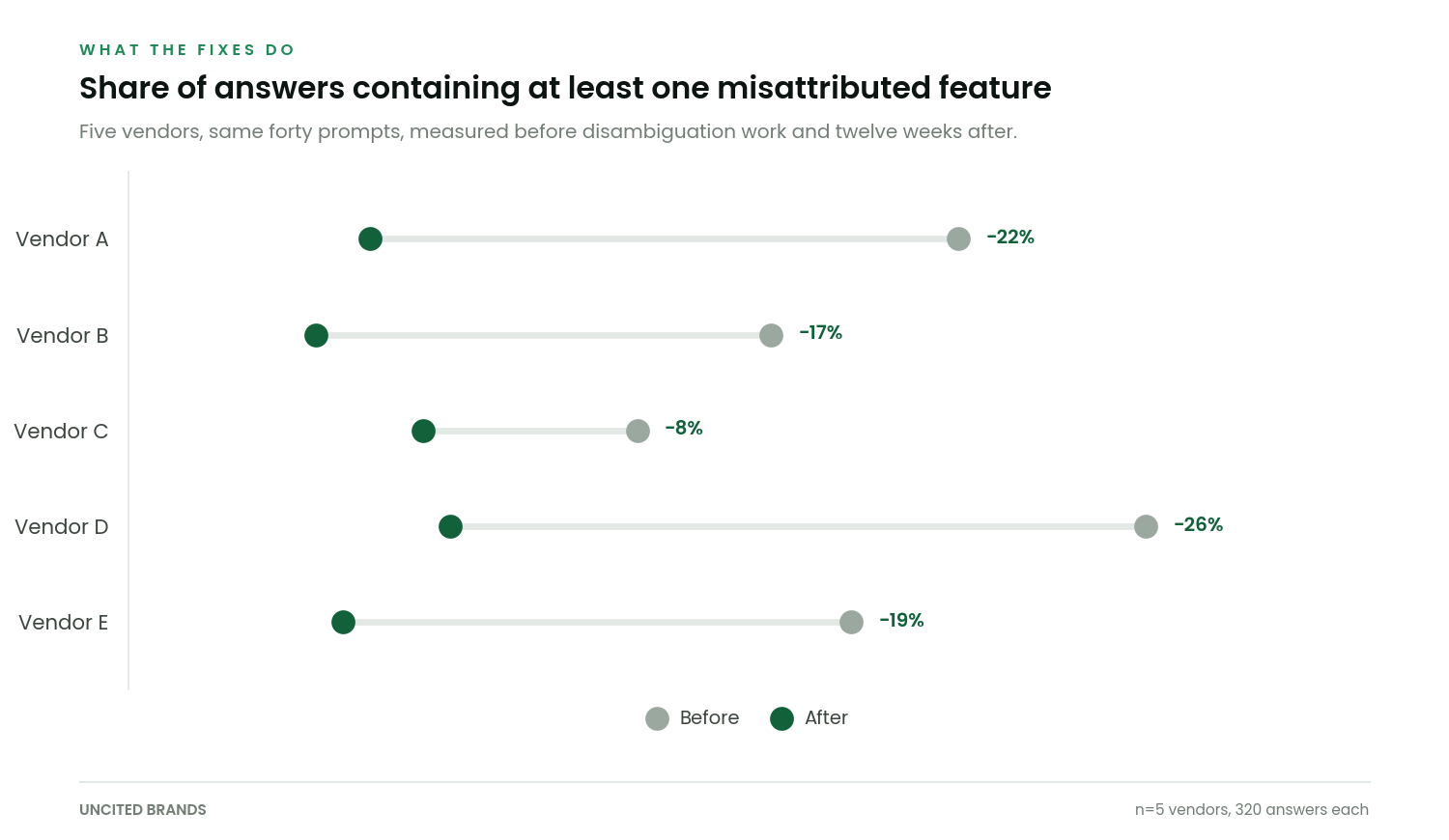
Those five accounts had different starting points and did the same four things. The vendor starting at thirty eight percent had two products with suffix names sharing a pricing page, which is the worst case and also the most improvable. The one starting at nineteen percent was already reasonably well separated and got the least benefit, which is the pattern you would expect.
None reached zero and we would be suspicious of a method that claimed to. Some residual confusion is just the cost of operating in a category where every competitor describes themselves with your vocabulary.
The part you cannot fix by writing
Entity linking research has spent two decades on the problem of mapping an ambiguous mention in text to the right entry in a knowledge base, and the honest summary is that it works well when the knowledge base is good and fails in predictable ways when it is not. Groups like the Stanford NLP group have published a lot of the foundational work, and projects such as DBpedia exist specifically to give machines structured entities to link against.
What this means practically is that your job is not to persuade a model. It is to make the knowledge base describe you accurately, because the model is reading that rather than your positioning deck. How knowledge graphs work covers the mechanism in more detail, and it is the thing most teams skip.
Related reading
- What an entity is. The underlying concept this entire failure mode rests on.
- How AI narrows the category. Why being hard to place is expensive before any confusion starts.
- Organization schema. The company node every product node should point back at.
- Four usual causes. Entity confusion is one of them, and rarely the first to check.
Pick the string. Use the string. Then go and fix the directories.
That is most of the work. It is not interesting and it does not make a good slide, and it reliably removes between half and two thirds of the misattribution we measure.
If you want the attribution map for your own products before you start, the free check produces it and you keep it regardless.

Shaban runs answer engine optimisation for B2B SaaS companies at Uncited Brands. He works the unglamorous end of the problem, mostly crawler access, retrieval diagnostics and measurement baselines, and publishes the tests that do not go his way alongside the ones that do.